The Big News That Shook Legal and Tech Markets
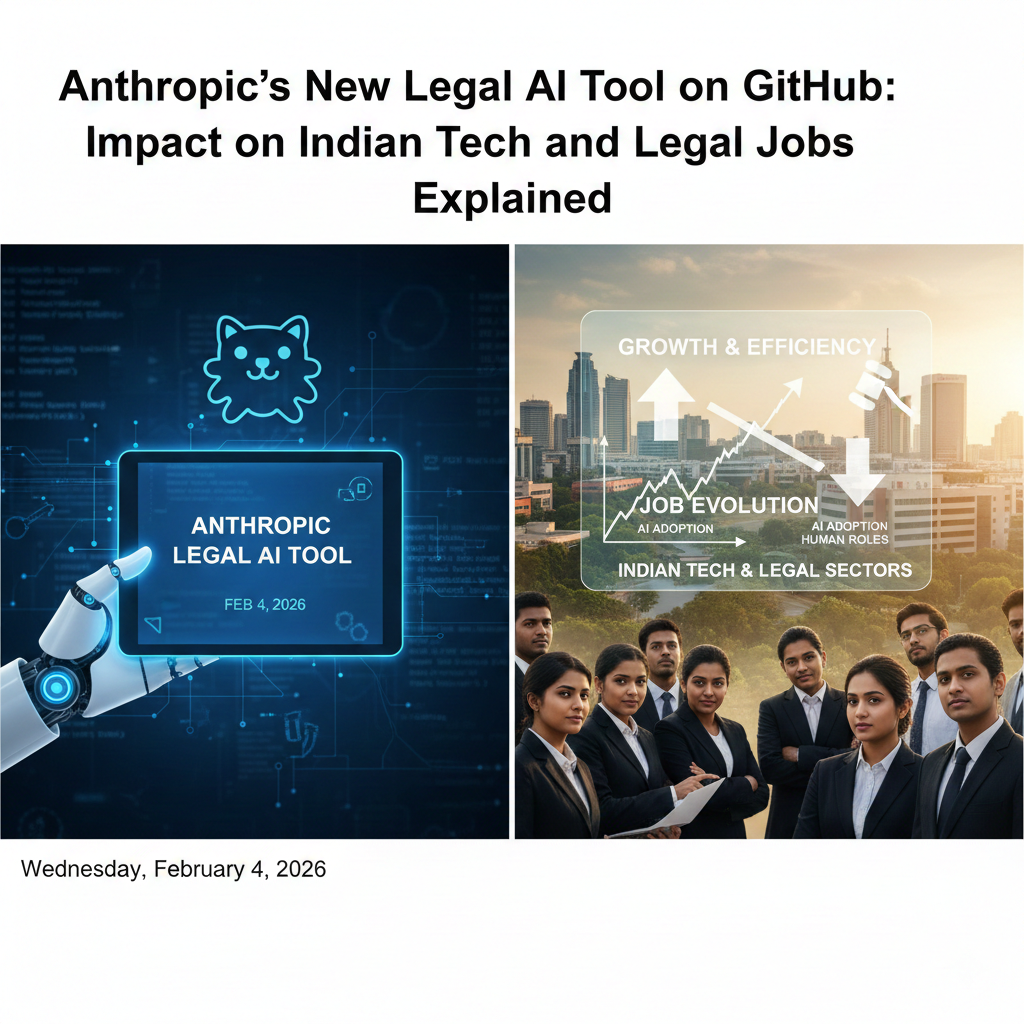
Anthropic recently launched a groundbreaking legal AI plugin for Claude Cowork on GitHub, and the announcement sent shockwaves through both legal‑tech and software markets. Within hours, global software stocks tumbled and Indian IT companies saw sharp drops as investors realized: if one general AI platform can automate specialized legal workflows, it could reshape entire legal‑software and outsourcing ecosystems.
If you’re already familiar with how Claude works as an AI assistant, this new plugin is like adding a “legal‑mode” layer on top of the same core engine you’ve read about in our earlier post: How to Use Claude AI for Legal and Business Workflows.
Anthropic’s legal AI tool wiped $285 billion off software stocks in a single day, and markets are still trying to digest what it means for legal-tech, SaaS, and Indian IT services. The announcement of a legal plugin for Claude Cowork—capable of automating contract review, NDA triage, and compliance checks—triggered panic selling across the software sector as investors confronted an uncomfortable question: if one general AI platform can replace dozens of specialized legal software tools, what happens to the companies that built them? The fallout has been swift, with legal-tech stocks plummeting and Indian IT service providers scrambling to reassess their business models.
What Exactly Is Anthropic’s New Legal AI Tool?
Anthropic’s latest innovation is a legal plugin for Claude Cowork, their enterprise AI agent platform. Unlike a generic chatbot, this plugin is tuned to automate routine but high‑volume legal tasks that usually eat up hours of a lawyer’s day.
For a deeper look at how Claude Cowork functions as an agentic assistant (reading files, calling tools, and running workflows), see our guide: Claude Cowork Explained: The Enterprise AI Agent for Teams.
Core Features of the Legal AI Plugin
The plugin automates several key workflows:
- Contract Review – Scans agreements clause‑by‑clause, flags deviations from your negotiation playbook, and suggests redlines with GREEN/YELLOW/RED risk indicators.
- NDA Triage – Quickly screens incoming NDAs and routes them to “standard approval,” “counsel review,” or “full review.”
- Compliance Checks – Cross‑references documents against internal policies and regulatory requirements.
- Legal Briefings – Summarizes case law, statutes, or dense legal documents.
- Templated Responses – Drafts first‑pass legal emails, memos, and standard replies.
This is the kind of automation you can already experiment with in simpler form using Claude’s document‑reading and prompting features, which we covered in: How to Review Contracts and NDAs Using Claude AI.
Built for In‑House Legal Teams, Not Law Firms
The tool is aimed squarely at in‑house legal departments, not law firms or solo practitioners. It assumes you already have:
- A negotiation playbook configured
- Internal risk thresholds defined
- A workflow where human lawyers review and approve all AI‑generated outputs
If you’ve read our earlier piece on Using Claude for Internal Compliance and Policy Checks, you’ll recognize this as the same pattern: AI does the heavy lifting; humans do the final judgment

Anthropic vs Other Legal AI Tools: What Makes It Different?
Anthropic isn’t the first in legal AI—players like Harvey AI, Legora, Thomson Reuters CoCounsel, LexisNexis, and Spellbook already offer AI‑assisted contract review and research.
But Claude Legal is different because:
- It’s a plugin on a general‑purpose agent (Claude Cowork), not a standalone legal‑only app.
- It emphasizes safety, controlled workflows, and audit trails, which aligns with Anthropic’s broader focus on responsible AI.
- It integrates with existing enterprise tools (Slack, Box, Microsoft 365, etc.), reducing the need for a separate “legal AI platform.”
If you want to compare Claude with other AI‑legal tools in practice, our earlier guide Claude vs Other AI Legal Assistants: A Practical Comparison breaks down strengths and weaknesses.
Why Anthropic’s legal AI tool wiped $285 billion off software stocks
Anthropic’s legal AI tool wiped $285 billion off software stocks because it signaled a dramatic shift in how legal work, compliance, and enterprise documentation will be handled in the future. By automating complex legal research, contract analysis, and regulatory interpretation, the tool threatens the core revenue models of traditional legal-tech platforms, SaaS vendors, and IT service providers that rely heavily on manual processes and billable hours. Investors immediately priced in the risk of rapid customer churn, shrinking margins, and long-term disruption, triggering a massive sell-off across global software stocks. The speed and scale of the market reaction highlight how seriously investors are taking AI-led automation in the legal and enterprise services sectors.
Will This Tool Replace Junior Lawyers and Paralegals?
Yes and no. The automation threat is real for routine document work, but the outcome is more likely job transformation than elimination.
- Tasks at risk: first‑pass contract review, NDA triage, basic compliance checks, templated drafting.
- Tasks that grow in value: supervising AI outputs, client counseling, negotiation, litigation strategy, and complex advisory work.
For law students and early‑career professionals, learning how to prompt, review, and validate AI outputs is as important as knowing substantive law. Our earlier post How Law Students Can Use Claude AI to Study and Work Smarter shows concrete ways to build that skill early.
What This Means for India: Impact on IT Services and Legal Process Outsourcing
India has a special stake in this shift because of its large LPO (Legal Process Outsourcing) and IT services sectors.
- LPOs that focus on routine contract review and document analysis may see demand fall if global clients use Claude Legal‑style plugins for first‑pass work.
- Indian IT firms (TCS, Infosys, Wipro, HCL) that implement and customize legal software may face fewer projects if clients move to general AI platforms with plugins instead of niche SaaS.
However, there’s an upside for those who move up the value chain:
- Offering AI‑implementation and customization services for tools like Claude Cowork.
- Building India‑specific legal‑AI workflows for compliance, GST, labour law, and corporate governance.
For more on how Indian professionals can adapt, see our piece: How Indian Professionals Can Use Claude AI to Stay Competitive.
Simple FAQ: Your Questions Answered
Is Anthropic’s legal AI tool free?
No. It’s part of Claude Cowork, an enterprise product for paid Claude users (typically research‑preview or Pro/Max tiers). Exact pricing is set by Anthropic and enterprise contracts.
For a quick overview of Claude’s pricing and tiers, check: Claude Pricing and Plans: What You Need to Know.
Can this AI file a lawsuit by itself?
No. The plugin supports document processing, research, and drafting, but only licensed attorneys can file lawsuits, sign documents, or give binding legal advice.
Our earlier post Ethical and Legal Limits of AI in Law Practice explains where AI can and cannot act independently.
Should law students worry about their career prospects?
Law students should adapt, not panic. Skills like critical thinking, negotiation, client counseling, and courtroom advocacy will remain valuable, while routine tasks get automated.
Our guide How Law Students Can Future‑Proof Their Careers with AI walks through concrete steps to stay ahead.
Will this tool work in the Indian legal system?
The initial version is trained mainly on US/UK common‑law systems. For Indian law, it would need additional training on Indian statutes, case law, and procedures.
Our article Using Claude AI for Indian Law Research and Drafting explores how to adapt AI tools for local practice.
How accurate is the AI in spotting legal issues?
Anthropic claims high accuracy for Claude 4, but stresses that human review is mandatory. AI can miss context, hallucinate clauses, or misread nuances.
For best‑practice workflows, see our post: Best Practices for Reviewing AI‑Generated Legal Drafts.
Final Thoughts: Prepare, Don’t Panic
Anthropic’s legal plugin is a clear signal that AI is moving from “assistant” to “workflow engine” in legal and knowledge work. For India, this is both a threat and an opportunity: firms that adopt AI early, move up the value chain, and specialize in AI‑augmented legal work will gain a strong edge. Whether or not Anthropic’s legal AI tool wiped $285 billion off software stocks in a single day is a one-off event, the message is clear: AI-powered legal workflows are here to stay. The legal profession is entering a new era where routine document processing becomes automated, specialized software gets consolidated into general AI platforms, and human lawyers focus on judgment, strategy, and client relationships that machines cannot replicate. For legal professionals, software companies, and Indian IT services alike, the path forward isn’t resistance—it’s intelligent adaptation. Those who learn to harness these tools, develop complementary skills, and position themselves at the intersection of law and AI will find abundant opportunities in this transformed landscape.