Want to grow your small business but don’t have time or budget for a big team? Artificial intelligence isn’t just for tech giants anymore—it’s become the secret weapon that’s helping neighborhood shops, solo entrepreneurs, and family businesses compete like never before.
What is AI for Small Business? (And Why Should You Care?)
Think of AI as your tireless smart assistant that never sleeps, never takes breaks, and gets better at its job every day. It’s not about complicated robots or writing code—it’s software that can:
- Write your marketing emails and social posts
- Answer customer questions instantly, even at 3 AM
- Organize your finances and predict slow seasons
- Test which ads work best without wasting money
- Turn hours of boring tasks into minutes
The numbers don’t lie: According to recent studies, small businesses using AI tools report:
- 30-40% time savings on routine tasks
- 15-25% revenue increases from better marketing and customer service
- 20-35% reduction in customer acquisition costs
You don’t need a computer science degree or a massive budget. Many AI tools cost less than hiring a part-time employee and work around the clock.
Let’s dive into 15 practical ways small businesses like yours are using AI right now to save time, make more money, and serve customers better.
Marketing Use Cases: Get More Customers Without Breaking the Bank

1. AI Social Media Content Helper
The Problem: You know you should post regularly on Instagram, Facebook, and LinkedIn, but coming up with fresh ideas every day feels impossible when you’re running a business.
The AI Solution: Tools like ChatGPT, Jasper, or Copy.ai can generate dozens of post ideas, captions, and hashtags in seconds.
Real Example: Upload a photo of your new product, and AI creates 10 different caption variations—from professional to playful. You just pick the best one, maybe tweak a word or two, and post. What used to take 30 minutes now takes 3.
Quick Win: Ask AI to create a month’s worth of post ideas based on your business type. You’ll have your content calendar done before lunch.
2. Ad Copy and Creative Testing
The Problem: Running Facebook or Google Ads feels like gambling. You write one ad, cross your fingers, and hope it works.
The AI Solution: AI advertising tools like AdCreative.ai or built-in AI in Meta Ads Manager can generate 20+ variations of headlines, descriptions, and call-to-action buttons automatically.
Real Results: A small online boutique used AI to create and test 15 ad variations. The winning combination reduced their cost-per-customer by 22% in just two weeks—without increasing ad spend.
Pro Tip: Let AI write the first drafts of your ads, then test 5-10 variations simultaneously. The data will show you what your customers actually respond to, not what you think sounds good.
3. AI SEO Assistant
The Problem: You want locals to find your business on Google, but SEO feels like a mysterious black box that only experts understand.
The AI Solution: Tools like Surfer SEO, Frase, or even ChatGPT can handle:
- Keyword research for your city and industry
- Blog topic ideas that people actually search for
- Meta descriptions that improve click-through rates
- Internal linking suggestions to boost your site rankings
Local Business Angle: Ask AI to help you rank for searches like “best coffee shop in [your city]” or “emergency plumber near me.” Small tweaks to your website copy can put you on the first page of Google.
Example Prompt: “Give me 10 blog post ideas for a family-owned bakery in Austin, Texas that will help us rank for local searches and attract more customers.”
4. Email Marketing Personalization
The Problem: Sending the same generic email to everyone on your list results in low open rates and even lower sales.
The AI Solution: Email platforms with AI capabilities like Mailchimp, ActiveCampaign, or Klaviyo can:
- Segment customers automatically (new buyers, loyal fans, people who haven’t purchased in 90 days)
- Write personalized emails for each group
- Predict the best send times for each subscriber
Real Impact: A home decor shop implemented AI email segmentation and saw:
- 35% higher open rates
- 48% increase in click-throughs
- $12,000 additional revenue in one quarter—without hiring a marketing agency
Action Step: Start simple. Use AI to write three different email versions: one for new subscribers, one for repeat customers, and one to win back inactive shoppers.
5. Website Copy and Product Descriptions
The Problem: You have 50 products that need descriptions, but writing compelling copy that converts browsers into buyers takes forever.
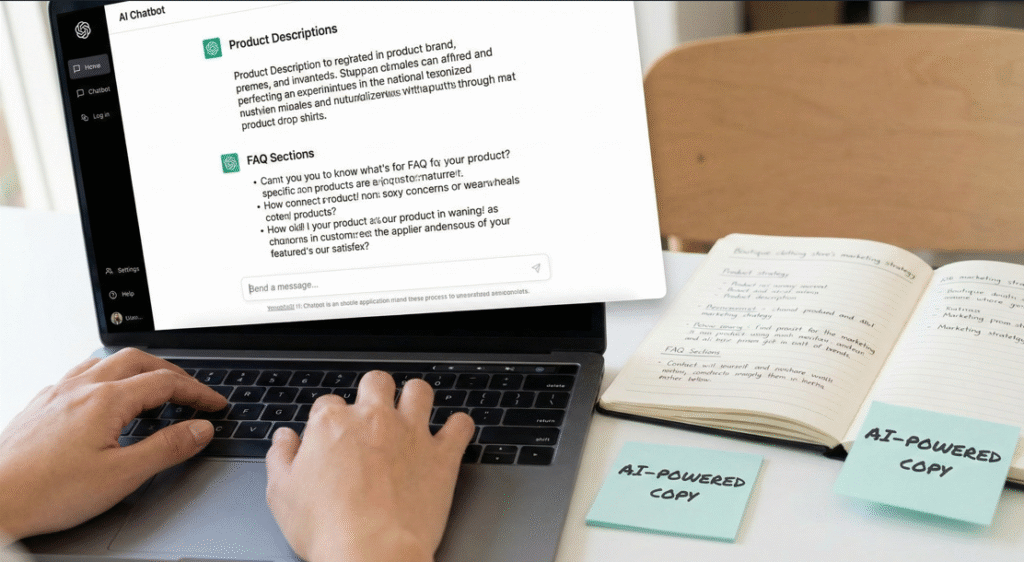
The AI Solution: Feed product details into tools like ChatGPT, Copy.ai, or Writesonic, and watch AI generate:
- Product descriptions highlighting benefits, not just features
- FAQ sections answering common questions
- Landing page copy in your brand’s tone
Case Study: A boutique clothing store used AI to rewrite all 120 product descriptions and A/B test different ad copy variations. The result? 15% lower customer acquisition cost and a 28% increase in average order value because descriptions better explained product value.
Time Saver: What would take a freelance copywriter 2-3 weeks and cost $2,000+ can be done in an afternoon for the cost of an AI subscription (often $20-50/month).
Customer Service Use Cases: Delight Customers Without Hiring a Team
6. 24/7 Chatbots on Website and WhatsApp
The Problem: Customers have questions at 9 PM on Sunday, but you’re closed. They message a competitor who responds instantly and you lose the sale.
The AI Solution: AI chatbots like Tidio, Intercom, ManyChat, or ChatGPT API can be set up to answer common questions instantly:
- “What are your hours?”
- “Do you ship to Canada?”
- “What’s your return policy?”
- “Do you have this in size Large?”
Real Results: A small outdoor gear shop added a chatbot to their website. In the first month:
- 68% of after-hours questions were answered without human involvement
- Customer satisfaction scores increased by 23%
- The owner reclaimed 10+ hours per week previously spent answering repetitive questions
Implementation: Most chatbot platforms offer templates for common industries. You can have a basic version running in under an hour.
7. AI Phone Agent for Missed Calls
The Problem: You’re a one-person operation or small team. When you’re with a customer, in a meeting, or after hours, calls go to voicemail—and many people won’t leave a message.
The AI Solution: AI phone answering services like Air.ai, PolyAI, or Dialpad can:
- Answer calls with a natural-sounding voice
- Book appointments in your calendar
- Collect customer information
- Route urgent calls to you
- Send you a summary of every conversation
Example: A small HVAC company in Phoenix installed an AI phone agent. In three months:
- Missed calls dropped by 50%
- Next-day booking rate increased by 20%
- The owner stopped losing weekend emergency calls to competitors
Cost-Benefit: At $50-200/month, an AI phone agent costs far less than a receptionist but works 24/7/365 without vacation days or sick leave.
8. Support Ticket Summarizer
The Problem: A customer sends a long, rambling email with their question buried in paragraph four. Your team wastes time reading everything or worse—misses the actual issue.
The AI Solution: AI tools can read entire email threads or support tickets and create bullet-point summaries:
- Main issue: Customer received wrong color item
- Order number: #12847
- Customer mood: Frustrated but polite
- Requested resolution: Exchange or refund
Time Saved: What takes a human 3-5 minutes to read and understand takes AI 10 seconds. For businesses handling 50+ support tickets daily, that’s hours saved every week.
Tools to Use: Zendesk with AI, Help Scout, or even ChatGPT connected to your email system via automation tools like Zapier.
9. AI That Knows Purchase History

The Problem: Customer service should increase sales, not just solve problems. But your team doesn’t always know what customers bought before.
The AI Solution: When AI chatbots or support systems connect to your CRM or order database, they can:
- See what a customer purchased previously
- Recommend complementary products
- Offer personalized upsells based on history
- Remind customers when it’s time to reorder
Revenue Example: A specialty pet food store connected their AI chat to purchase history. When customers asked questions, the bot would say: “I see Bella loved the salmon formula last time—we now have a grain-free version that might be perfect for her!” This turned customer service into a revenue generator, adding $8,000 in monthly sales from chat recommendations alone.
Systems That Do This: Gorgias, Kustomer, or custom ChatGPT implementations connected to Shopify or WooCommerce.
10. Feedback and Review Analysis
The Problem: You have 200 Google reviews, 150 Amazon ratings, and dozens of Instagram DMs with feedback. Reading them all to spot patterns is overwhelming.
The AI Solution: AI review analysis tools scan all your feedback and instantly tell you:
- Top 3 complaints customers mention most
- Top 3 things customers love (use these in marketing!)
- Emerging issues before they become big problems
- Sentiment trends over time
Business Impact: A small restaurant used AI to analyze reviews and discovered 18% of negative reviews mentioned “long wait times for takeout orders.” They adjusted staffing on busy nights and saw their rating climb from 4.2 to 4.7 stars in two months, bringing in noticeably more foot traffic.
Tools: MonkeyLearn, Brandwatch, or even spreadsheet analysis with ChatGPT can work for smaller review volumes.
Finance & Operations Use Cases: Run Your Business Smarter
11. Invoice and Receipt Processing
The Problem: At month’s end, you have a shoebox (or folder) full of receipts and invoices. Manually entering every expense into your accounting software takes hours and is mind-numbingly boring.
The AI Solution: AI receipt scanning tools like Expensify, Dext, QuickBooks with AI, or Receipt Bank can:
- Photograph or scan receipts
- Extract date, vendor, amount, category automatically
- Push data directly into your accounting system
- Flag duplicates or unusual expenses
Time Savings: A small marketing agency reduced monthly bookkeeping from 8 hours to 45 minutes using AI receipt processing. That’s nearly a full workday back every month.
Accuracy Boost: AI eliminates typos and math errors common with manual entry, making tax season far less stressful.
12. Cash Flow and Sales Forecasting
The Problem: You never quite know if next month will be feast or famine. Should you hire someone? Buy more inventory? Increase marketing spend? You’re flying blind.
The AI Solution: AI forecasting tools analyze your past sales patterns and predict:
- Expected revenue for next week, month, or quarter
- Slow periods when you should save money
- Peak seasons when you should stock up and hire temp help
- How different marketing investments might impact sales
Planning Power: A boutique gym used AI forecasting to predict their annual slow period in January (post-New Year’s resolution dropoff). They planned a special promotion ahead of time and kept revenue 18% higher than the previous January.
Tools to Try: Futrli, Float, QuickBooks Advanced, or AI add-ons for existing accounting software.
13. Expense Categorization & Budget Alerts
The Problem: You set budgets at the beginning of the year but don’t realize you’ve overspent on advertising or supplies until it’s too late to course-correct.
The AI Solution: AI-powered accounting assistants automatically:
- Categorize every expense (rent, ads, raw materials, office supplies, tools)
- Compare to your budget in real-time
- Send alerts when you’re approaching or exceeding limits
- Suggest optimizations based on spending patterns
Example: A freelance graphic designer set up AI budget alerts and discovered they were spending $380/month on software subscriptions they barely used. Canceling unnecessary tools saved $4,560 annually.
Think of It As: AI as your small business money watchdog—always watching, never judging, just keeping you informed.
Platforms: QuickBooks, Wave with AI features, Xero, or FreshBooks.
14. Fraud and Risk Monitoring (Basic Level)
The Problem: As a small ecommerce business, you occasionally get fraudulent orders—stolen credit cards, fake addresses, or scam chargebacks that cost you product AND money.
The AI Solution: AI fraud detection tools analyze hundreds of signals to flag suspicious orders:
- Mismatched billing and shipping addresses
- Orders from high-risk countries for your product type
- Unusual purchasing patterns (10 of the same expensive item)
- Velocity checks (same card used multiple times quickly)
Protection Example: A small electronics reseller implemented basic AI fraud detection through their payment processor. In six months:
- Chargebacks dropped by 67%
- Saved approximately $11,000 in fraudulent orders
- Time spent dealing with fraud disputes decreased dramatically
Available In: Stripe Radar, Shopify Fraud Analysis, PayPal Fraud Protection, or Signifyd for larger operations.
15. Task and Workflow Automation
The Problem: Your daily workflow involves copying information between apps, sending routine emails, updating spreadsheets, and notifying team members. It’s repetitive, error-prone, and wastes valuable time.
The AI Solution: AI-powered automation platforms like Zapier, Make (formerly Integromat), or Microsoft Power Automate can connect your business tools and create automatic workflows:
Example Workflow:
- Customer fills out a contact form on your website
- AI automatically adds them to your CRM with proper tags
- Sends a personalized welcome email based on what they’re interested in
- Notifies your sales team on Slack
- Creates a follow-up task in your project management tool
- Adds their info to a Google Sheet for reporting
All of this happens in seconds, with zero human effort.
Real Business Impact: A home services company automated their lead intake process. Before: leads sat in an inbox for hours, and 30% were never followed up. After: every lead got an instant response and proper follow-up task created. Conversion rate increased by 42% simply by eliminating delays and dropped balls.
Start Simple: Begin with one repetitive task that annoys you daily. Automate that, see the magic, then expand.
Small Business Voice AI Success Stories in 2026
Salon Success: 40% Fewer Missed Calls A family-owned salon in Austin, Texas deployed an AI phone agent in early 2026 and saw immediate results. The system handles appointment bookings, cancellations, and common questions 24/7. Within 60 days, missed calls dropped by 40%, and Saturday bookings increased 28% as clients could schedule outside business hours.
HVAC Company: $15K Monthly Revenue Boost A small HVAC service provider in Phoenix implemented voice AI for after-hours emergency calls and appointment scheduling. The AI qualifies leads, books service appointments, and handles routine inquiries. Result: 15% more booked appointments and an estimated $15,000 in monthly revenue that previously went to competitors when calls went unanswered.
Medical Clinic: 3 Hours Saved Daily A local family practice in Ohio uses an AI voice assistant to handle appointment confirmations, prescription refill requests, and basic triage questions. The front desk staff now saves approximately 3 hours daily, allowing them to focus on in-person patient care and complex insurance issues.
AI Services for Local Businesses in the US (2026 Opportunities)
Top AI Applications for Local US Businesses:
- Local Restaurants: AI voice agents manage phone orders, take reservations, answer menu questions, and handle delivery coordination—freeing staff to focus on food quality and in-person service.
- Local Clinics & Salons: AI phone reception systems handle appointment scheduling, send WhatsApp/SMS reminders, answer FAQs about services and pricing, and manage cancellations without human intervention.
- Local Home Services (plumbers, electricians, HVAC): 24/7 AI call handling qualifies emergency vs. routine calls, books appointments based on technician availability, and collects project details before dispatch—improving response times and customer satisfaction.
Why 2026 Is the Breakthrough Year: AI services for local businesses in the US have reached a price-performance sweet spot. Entry-level voice AI solutions now start at $99–$299/month—comparable to a part-time receptionist but available 24/7. These 2026 AI opportunities for local small businesses include no-code setup tools, seamless integration with existing scheduling software (Calendly, Square, Housecall Pro), and pay-as-you-go pricing that scales with call volume.
Quick ROI: Most local businesses report positive ROI within 60–90 days through reduced missed opportunities, lower staffing overhead, and improved customer experience scores.
Getting Started: Your AI Implementation Roadmap
Feeling overwhelmed by all these possibilities? Here’s how to start small and build from there:
Week 1: Identify Your Biggest Pain Point
Ask yourself: “What repetitive task wastes the most time in my business?” Start there.
- Is it answering the same customer questions over and over? → Try a chatbot
- Is it creating social media content? → Try an AI content generator
- Is it bookkeeping? → Try AI receipt processing
Week 2: Try One Tool (Many Are Free to Start)
Most AI tools offer free trials or freemium plans. Test one for 14 days without any commitment. See if it actually saves you time.
Week 3-4: Measure the Impact
Track concrete metrics:
- Hours saved per week
- Customer satisfaction changes
- Revenue impact
- Stress level (seriously—this matters!)
Month 2: Add a Second Use Case
Once you’ve mastered one AI tool and seen results, add another. Build your AI toolkit gradually.
Common Concerns About AI for Small Business
“Isn’t AI expensive?” Many AI tools cost $10-50/month—less than hiring someone for a single hour. The ROI often appears in the first month.
“I’m not tech-savvy. Will this be too complicated?” Modern AI tools are designed for non-technical users. If you can use Facebook or send emails, you can use AI business tools. Most have templates and step-by-step guides.
“Will AI replace my employees?” Think of AI as giving your small team superpowers, not replacing them. AI handles boring, repetitive work so humans can focus on creativity, relationships, and judgment calls that actually grow your business.
“What about data privacy?” Reputable AI platforms have strong security measures. Read privacy policies, choose established companies, and never feed sensitive customer data into free public AI tools. Use business-grade platforms with proper data protection.
“Is this just a trend?” AI adoption among small businesses grew 340% from 2022 to 2025 according to Forbes research. This isn’t a fad—it’s becoming as essential as having a website or accepting credit cards.
The Bottom Line: AI Levels the Playing Field
For decades, big corporations had advantages small businesses couldn’t match: armies of customer service reps, marketing departments, data analysts, and round-the-clock operations.
AI has changed the game.
Today, a solo entrepreneur or small team can:
- Provide 24/7 customer service like a Fortune 500 company
- Run sophisticated marketing campaigns previously requiring a full agency
- Make data-driven decisions that used to need an analytics team
- Automate operations that once required dozens of employees
You don’t need to implement all 15 use cases tomorrow. Start with one. See the results. Then add another. Within six months, you’ll wonder how you ever ran your business without AI assistance.
The question isn’t whether to adopt AI for your small business. The question is: which use case will you implement first?
Helpful Resources to Get Started
AI Learning Resources:
- AI for Small Business Guide – U.S. Small Business Administration
- AI Business Tools Directory – G2 Reviews and Comparisons
- Google Digital Garage AI Training – Free courses
Community and Support:
- Small Business AI Community on Reddit
- Local Chamber of Commerce tech workshops
- SCORE – Free business mentoring including technology adoption