Introduction
Finance Minister Nirmala Sitharaman made history on February 1, 2026, by presenting her ninth consecutive Union Budget in Parliament – a remarkable milestone that no other finance minister in India has achieved. This budget presentation was also historic for being the first Union Budget ever presented on a Sunday in independent India’s history.
Before heading to Parliament, the Finance Minister met with President Droupadi Murmu at Rashtrapati Bhavan to brief her on the budget. Following tradition, President Murmu offered curd and sugar (dahi-shakkar) to Sitharaman for good luck.
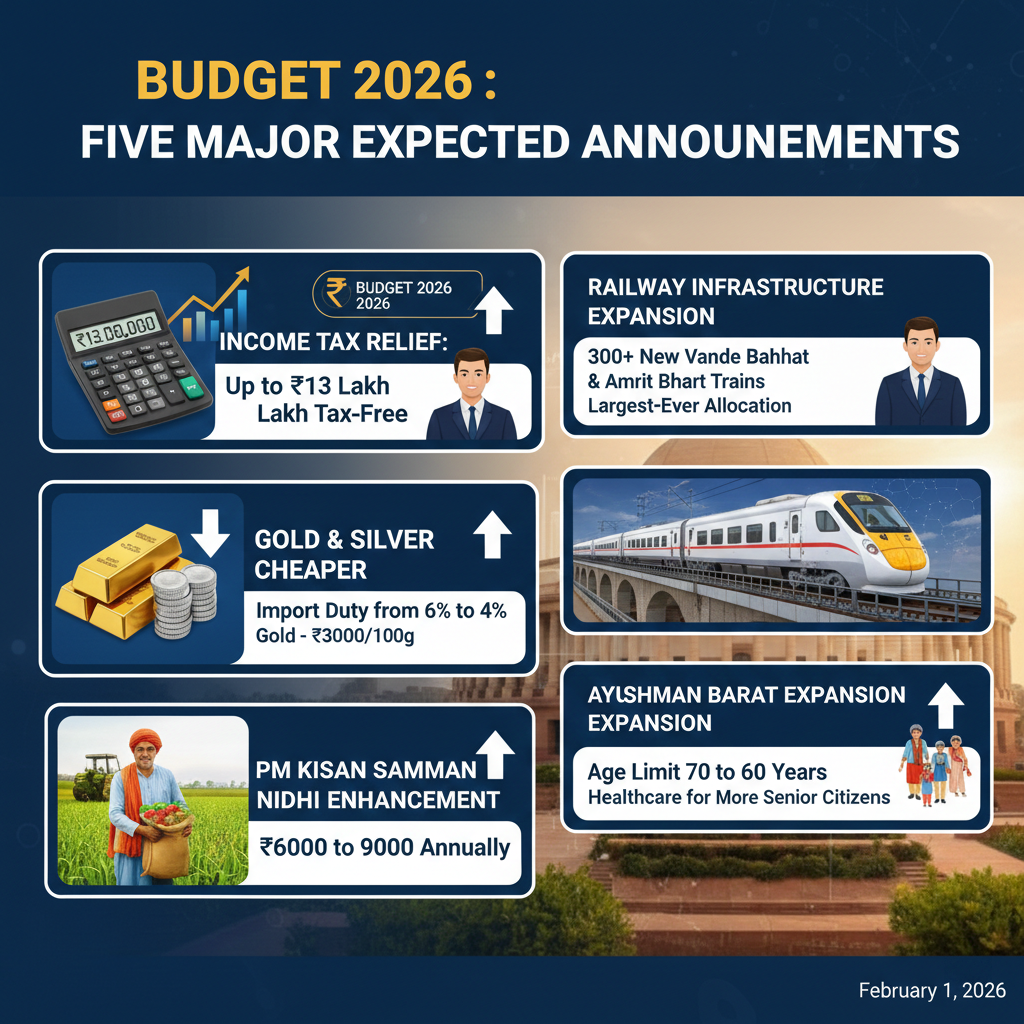
Budget 2026: Five Major Expected Announcements
According to market speculation and expert analysis, the government is expected to make five significant announcements in this budget:
1. Income Tax Relief for Salaried Class
One of the most anticipated announcements is the potential increase in the tax-free income limit for salaried individuals to ₹13 lakh annually in the new tax regime. This would be achieved by raising the standard deduction from ₹75,000 to ₹1 lakh.
2. Reduction in Gold and Silver Prices
Import duty on gold and silver could be reduced from the current 6% to 4%, potentially making gold cheaper by approximately ₹3,000 per 10 grams and silver by around ₹6,000.
3. PM Kisan Samman Nidhi Enhancement
The PM-Kisan scheme amount might be increased from ₹6,000 to ₹9,000 annually, providing additional financial support to farmers who have been requesting this enhancement for the past 2-3 years.
4. Railway Infrastructure Expansion
To reduce waiting lists and improve connectivity, the government may announce 300+ new Amrit Bharat and Vande Bharat trains, along with the largest-ever allocation to the railway sector.
5. Ayushman Bharat Expansion
The age limit for the Ayushman Bharat (PM-JAY) scheme could be reduced from 70 years to 60 years, extending healthcare coverage to more senior citizens.
Key Budget Announcements Made by Finance Minister
Infrastructure Development
Capital Expenditure Increase
- For the financial year 2026-27, the government has allocated ₹12.2 lakh crore for capital expenditure (capex)
- This represents an increase from the previous year’s ₹11.2 lakh crore
- Focus on developing Tier-2 and Tier-3 cities with populations exceeding 5 lakh
Railway Corridor Development
- Seven high-speed rail corridors announced, including:
- Mumbai to Pune
- Pune to Hyderabad
- Hyderabad to Bangalore
- Hyderabad to Chennai
- Siliguri to Varanasi
- New freight corridor from Dankuni (West Bengal) to Surat to facilitate cargo transportation
- Dedicated freight corridors to connect ports from east to west
Waterways Development
- Development of inland waterways through Varanasi and Patna
- Training programs for utilizing waterways for transportation
Strategic Manufacturing Initiatives
Biopharma SHAKTI
- Launch of ‘Bio-Pharma SHAKTI’ scheme with ₹10,000 crore investment
- Three new institutions to be established
- Goal: To make India a global bio-pharma manufacturing hub
- Creation of 1,000 accredited clinical sites for scientific review
India Semiconductor Mission 2.0
- Launch of ISM 2.0 to boost domestic chip manufacturing
- Focus on production and development of Indian intellectual property
- Strengthening supply chain capabilities
Electronics Manufacturing
- Budget allocation of ₹40,000 crore for manufacturing electronic equipment
- Support for mobile and other electronics spare parts production
Rare Earth Mineral Corridors
- Dedicated rare earth corridors announced for:
- Odisha
- Tamil Nadu
- Andhra Pradesh
- Kerala
- Creation of dedicated mineral parks in these states
Textile Sector Development
- Establishment of mega textile parks across the country
- National Fiber Scheme for man-made and advanced fibers
- National Handloom Policy to encourage and support artisans
- Technical assistance from academic institutions
- Promotion of One District, One Product initiative
Mahatma Gandhi Gram Swaraj Initiative
- Support for khadi production, training, and marketing
- Strengthening traditional craft industries
MSME Support Measures
Financial Support Mechanisms
- Creation of Atmanirbhar Bharat Fund for micro-enterprises
- Transaction Settlement Program for liquidity support
- Credit Guarantee Support Mechanism
- Asset-based security provisions
- Linking GEM (Government e-Marketplace) with trade
Skill Development
- Government institutions directed to design short-term modular courses
- Training to be extended to Tier-2 and Tier-3 cities
- Vocational assistance programs
Healthcare and Ayurveda
Ayurvedic Medicine Development
- Three new AIIMS for Ayurveda to be established
- National labs for testing Ayurvedic medicines
- WHO Traditional Medicine Center to be set up in Jamnagar
- Export promotion of high-quality Ayurvedic products globally
Healthcare Professional Training
- Creation of 1 lakh specialized healthcare professionals over the next five years
- Training of 1.5 lakh caregivers
- Youth career pathways in healthcare sector
Sports and Infrastructure
- New schemes for designing and manufacturing sports equipment
- Industrial cluster improvements for infrastructure and technology
- Seaplane manufacturing support for enhanced connectivity
Banking and Financial Sector
- High-Level Banking Committee for Viksit Bharat (Developed India)
- Infrastructure Risk Guarantee Fund for private developers with partial government guarantee
- Real estate recycling schemes
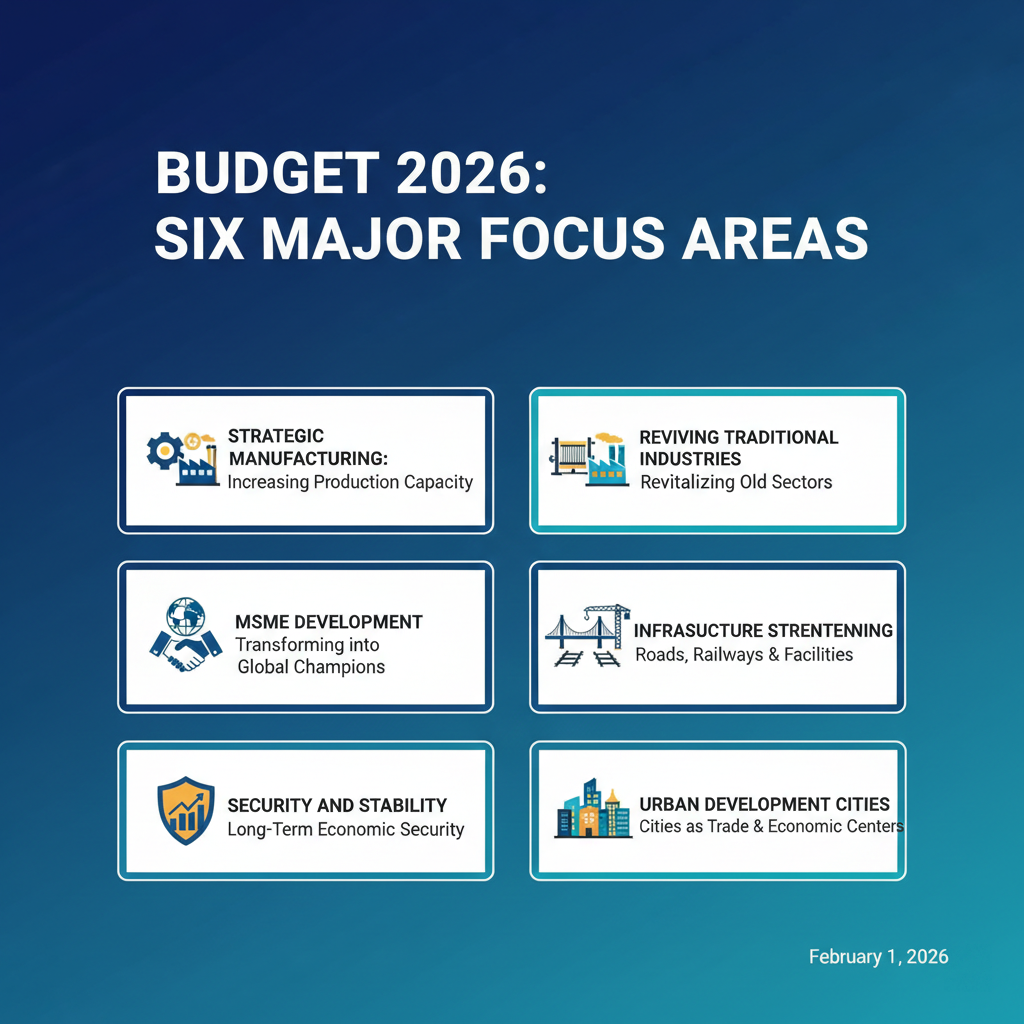
Six Major Focus Areas of the Budget
- Strategic Manufacturing: Increasing production capacity in new and essential sectors
- Reviving Traditional Industries: Revitalizing old and declining industrial sectors
- MSME Development: Transforming small and medium enterprises into global champions
- Infrastructure Strengthening: Robust development of roads, railways, and other basic facilities
- Security and Stability: Ensuring long-term economic security for the nation
- Urban Development: Developing cities as trade and economic centers.
Three Core Duties and Vision of the Budget
1. Speed (Gati)
Accelerating economic growth by increasing productivity
2. Capability (Kshamata)
Enhancing people’s skills so they can become partners in the nation’s progress
3. Everyone’s Participation (Sabka Saath)
Ensuring every family and sector has adequate resources and opportunities for earning
Government’s Report Card on the Economy
Self-Reliance (Atmanirbharta)
India has increased its manufacturing and energy security, reducing dependence on imports from abroad.
Growth Rate
Due to past reforms, India is achieving a 7% growth rate, which has helped reduce poverty.
12-Year Journey
The Finance Minister stated that over the last 12 years, India’s economy has remained stable with inflation under control.
Global Challenges
Despite global challenges in trade and supply chains, India continues to take steps toward becoming a ‘Viksit Bharat’ (Developed India).
Middle Class Wishlist: 5 Major Expectations
1. Income Tax Relief
Increase in standard deduction from ₹75,000 to ₹1 lakh in the new tax regime, making income up to ₹13 lakh tax-free for salaried individuals (₹12.75 lakh for non-salaried).
2. PM Kisan Samman Nidhi
Increase in the scheme amount from ₹6,000 to ₹9,000, with discussions ongoing for approximately 2-3 years.
3. Railway Infrastructure
Announcement of 300+ new Amrit Bharat and Vande Bharat trains to reduce waiting lists, with the largest-ever fund allocation to railways.
4. PM Surya Ghar Yojana
Increase in subsidy for solar systems up to 2 kW from ₹30,000 per kilowatt to ₹40,000.
5. Ayushman Bharat Expansion
Expansion of the Ayushman Bharat (PM-JAY) scheme by reducing the age limit from 70 years to 60 years for senior citizens.
What Could Get Cheaper or More Expensive
Items Expected to Get Cheaper
Gold and Silver: If the Basic Customs Duty is reduced from 6% to 4%, gold could become cheaper by approximately ₹3,000 per 10 grams and silver by around ₹6,000.
Important Note on Pricing
Most items, from vegetables in your plate to smartphones in your hand, have their prices determined by the GST Council, not the Finance Minister. The budget primarily affects items through changes in import duties.
Key Political Reactions
Commerce Minister Piyush Goyal
Expressed confidence that Budget 2026-27 will be excellent, noting that PM Modi and the Finance Minister have delivered outstanding budgets over the years.
Rajya Sabha MP Kapil Sibal (Opposition)
Questioned whether the budget would reduce pain for the poor, expressing doubts based on previous budget outcomes.
Congress MP Shashi Tharoor
Emphasized that growth without job creation is meaningless, eagerly awaiting schemes that will provide employment to youth.
SP President Akhilesh Yadav
Criticized that budgets in recent years have been for only 5% of the population, questioning whether the government has fulfilled its promises.
Congress Leader Priyanka Gandhi
Stated she had no special expectations from the budget.
Historic Significance
This budget marks several historic milestones:
- First time a Union Budget is presented on a Sunday in independent India
- Ninth consecutive budget by Finance Minister Nirmala Sitharaman, breaking all previous records
- Brings her one step closer to former Prime Minister Morarji Desai’s record of presenting the budget 10 times
- PM Modi noted that this achievement will be recorded as a matter of pride in India’s parliamentary history
Budget Preparation Team
Finance Minister Sitharaman was supported by a core team of top bureaucrats and advisors, including:
- Anuradha Thakur
- V. Anantha Nageswaran (Chief Economic Advisor)
- Other key officials from the Ministry of Finance
Economic Survey Highlights
The Economic Survey 2026-27, presented on January 31, projected:
- India’s GDP growth at 6.8-7.2% for FY 2026-27
- Upgrade of India’s medium-term potential growth rate to 7% from 6.5%
- Strong macroeconomic stability
- Emphasis on ‘swadeshi’ (self-reliance) as a key strategic element
Traditional Budget Rituals
Halwa Ceremony
The traditional Halwa ceremony was conducted before the budget presentation, marking the beginning of the lock-in period when key officials are restricted from leaving the budget preparation premises to maintain secrecy.
President’s Blessing
Finance Minister Sitharaman wore a handwoven Kanjivaram silk saree – a purple Kattam Kanjivaram with light golden-brown checks and coffee-brown borders – representing Tamil Nadu’s centuries-old weaving heritage.
Market Response
- Stock markets remained open on Sunday, February 1, 2026, for Budget Day trading – a rare occurrence
- Both NSE and BSE held full trading sessions
- Volatility index increased by 3% ahead of the budget speech
- Gold and silver prices showed sharp movements in anticipation of duty changes
Agriculture and Women Empowerment Initiatives
AI-Powered Agricultural Tools for Farmers
The government has announced the introduction of AI-powered agricultural tools to help farmers improve productivity and make data-driven decisions. These tools will assist farmers with:
- Crop planning and management
- Weather prediction and risk assessment
- Soil health monitoring
- Pest and disease detection
- Market price forecasting
She-Mart: Women’s Entrepreneurship Platform
A new initiative called “She-Mart” has been launched to promote women’s entrepreneurship and support women-led businesses. This platform will:
- Provide market access to women entrepreneurs
- Offer business development support and training
- Create dedicated spaces for women to showcase and sell their products
- Connect women-led enterprises with larger markets and supply chains
Major Tax Reforms and Relief Measures
Income Tax Exemptions and Reliefs
Motor Accident Claims
Motor accident claim compensation amounts have been exempted from income tax, providing relief to victims and their families during difficult times.
New Income Tax Act Implementation
- The new Income Tax Act will come into effect from April 1, 2026
- Simplified tax forms have been redesigned to make them easier for common citizens to understand and fill
- Focus on reducing complexity and improving taxpayer experience
TCS (Tax Collected at Source) Reductions
Foreign Travel
- TCS on overseas tour packages reduced from 5% to 2%
- This will make international travel more affordable for Indian tourists
Education and Medical Treatment Abroad
- TCS on foreign education expenses reduced from 5% to 2%
- TCS on medical treatment abroad reduced from 5% to 2%
- This significant reduction will ease the financial burden on families seeking education and healthcare overseas
Employment Services
- Tax on employee hiring services increased from 1% to 2%
Middle-Class Tax Relief
The Finance Minister emphasized providing relief to the middle class through various tax measures, making disposable income higher for salaried individuals and families.
Tourism and Healthcare Development
Buddhist Circuit Development (Purvodaya Scheme)
The government has announced the development of Buddhist Circuits in five northeastern states:
- Arunachal Pradesh
- Assam
- Sikkim
- Mizoram
- Tripura
This initiative aims to boost religious tourism and preserve Buddhist heritage while creating employment opportunities in these regions.
Medical Tourism Hub Initiative
India will be promoted as a global medical tourism hub with the establishment of 5 regional hubs across the country. The scheme will:
- Support states in establishing specialized medical tourism facilities
- Develop world-class healthcare infrastructure
- Position India as a preferred destination for international patients
- Create employment in the healthcare and hospitality sectors
Emergency and Trauma Care Centers
New emergency and trauma care centers will be established across the country to improve emergency medical response and save lives.
Customs Duty Relief and Tax Exemptions
Healthcare and Medical Relief
Cancer Medications
- Customs duty exemption announced on 17 cancer drugs
- This will make life-saving cancer medications more affordable for patients
- Significant relief for families dealing with cancer treatment costs
Diabetes and Serious Disease Medications
- Medicines for cancer and diabetes will become cheaper
- Reduction in customs duties on critical healthcare products
Manufacturing and Import Relief
Civil Aircraft Components
- Zero tax on imported materials used for manufacturing civilian aircraft parts
- This will boost domestic aircraft manufacturing and reduce costs
Microwave Oven Components
- Import duty exemption on parts used for manufacturing microwave ovens
- Expected to reduce prices of locally manufactured kitchen appliances
Personal Import Tariff Reduction
- Tariff on all goods imported for personal use reduced from 20% to 10%
- This 50% reduction will make international shopping more affordable for individuals
Leather Industry Support
- Leather products, shoes, and bags will become cheaper
- Reduction in import duties to boost the domestic leather industry
- Support for traditional leather craftsmanship
Technology and Infrastructure
Data Center Tax Exemption
- No tax on data centers until 2047
- This historic exemption aims to position India as a global data center hub
- Expected to attract massive foreign investment in digital infrastructure
Solar Equipment
- Materials and equipment for solar energy will become cheaper
- Reduction in customs duties to promote renewable energy adoption
- Support for PM Surya Ghar Yojana and clean energy initiatives
SVGC Sector Promotion
The government announced encouragement and promotion for India’s SVGC (Specified Valuable Goods and Commodities) sector to boost domestic production and exports.
Agriculture and Plantation Sector Initiatives
Coconut Development Scheme
Finance Minister Sitharaman announced a comprehensive Coconut Development Scheme to enhance production and competitiveness. The scheme includes:
Key Features:
- Replacement of unproductive coconut trees with new high-yielding varieties in major coconut-growing states
- Multiple approaches to increase production and improve productivity
- Focus on modernizing coconut farming practices
- Support for value-added coconut products
Indian Cashew and Cocoa Program
A special program has been proposed for Indian cashew and cocoa with ambitious goals:
Objectives:
- Make India self-reliant in raw cashew and coconut production and processing
- Increase export competitiveness of Indian cashew and cocoa products
- Transform “Indian Cashew” and “Indian Cocoa” into premium global brands by 2030
- Support farmers with better technology and processing facilities
- Enhance value chain integration from farm to export
This initiative aims to position India as a major player in the global cashew and cocoa markets while ensuring better returns for farmers.
Income Tax Slabs – No Changes
The Finance Minister clarified that no changes have been made to income tax slabs in this budget. The existing tax structure under both old and new tax regimes remains unchanged.
Fiscal Discipline and State Support
Budget Estimates and Expenditures
Revenue Projections
- Total tax revenue estimate: ₹34 lakh crore
- Total budget estimate: ₹36.5 lakh crore
- Capital expenditure: ₹11 lakh crore
Fiscal Deficit Targets
The government has set ambitious fiscal consolidation targets:
- Fiscal deficit target: To be maintained below 4.5% of GDP
- Debt-to-GDP ratio: Target to keep public debt around 50% of the economy by 2031
These targets demonstrate the government’s commitment to maintaining fiscal discipline while supporting growth.
Support to State Governments
16th Finance Commission Recommendations
The government has accepted the recommendations of the 16th Finance Commission regarding resource allocation to states.
Rural and Urban Development
- ₹1.4 lakh crore allocated for the development of rural and urban local bodies
- This funding will help states improve local infrastructure and governance
- Focus on grassroots development and empowering local institutions
Conclusion
Union Budget 2026 represents a comprehensive vision for India’s economic growth, focusing on infrastructure development, strategic manufacturing, MSME support, and inclusive development. With allocations aimed at various sectors from healthcare to railways, textiles to semiconductors, the budget attempts to balance growth acceleration with fiscal discipline while addressing global economic uncertainties.
Key highlights of this historic budget include:
- Significant tax relief for the middle class through reduced TCS rates
- Women empowerment through the She-Mart initiative
- Agricultural modernization with AI-powered tools
- Medical tourism promotion to position India globally
- Buddhist circuit development in the Northeast
- Fiscal responsibility with clear deficit and debt targets
- Substantial support to state governments for local development
The government’s focus on self-reliance, technological advancement, and rural-urban development reflects its commitment to achieving the ‘Viksit Bharat’ vision by 2047. As Finance Minister Sitharaman emphasized, this budget continues the government’s efforts to ensure that growth benefits reach farmers, tribal communities, women, and youth across the nation, while maintaining economic stability and fiscal prudence.