
Winter Olympic Games – Complete Guide From 1924 To 2026
The Winter Olympic Games 2026 complete guide you’re reading covers everything about the Winter Olympics, from their 1924 origins to Milan–Cortina 2026. You’ll learn how the Winter Olympic Games started, which sports are on the programme today, which countries dominate the medal table, and what challenges and changes shape the future of the Games.
The Winter Olympic Games are the world’s biggest snow‑and‑ice sports event, held every four years and governed by the International Olympic Committee (IOC). Their story runs from the first edition in Chamonix in 1924 through Cold War rivalries and TV booms to Beijing 2022 and the upcoming Milan–Cortina 2026.
If you want to understand how the Winter Olympics evolved, which sports are included, and which nations dominate, this guide brings everything together in one place. For a broader view that includes the Summer Games as well, you can read our complete Olympics history guide.
What Are the Winter Olympic Games?
The Winter Olympic Games are a major international multi‑sport event focused only on sports practised on snow or ice. They are held once every four years, usually in February, and run separately from the Summer Olympic Games.
The first official Winter Olympic Games took place in 1924 in Chamonix, France, after the IOC created a dedicated winter sports week that was later recognised as the I Winter Olympics. Since then, the Games have grown from a handful of ice and Nordic events to a full programme of traditional and modern action sports.
If you are new to the overall Olympic Movement, start with our primer on the IOC and the Olympic Charter.
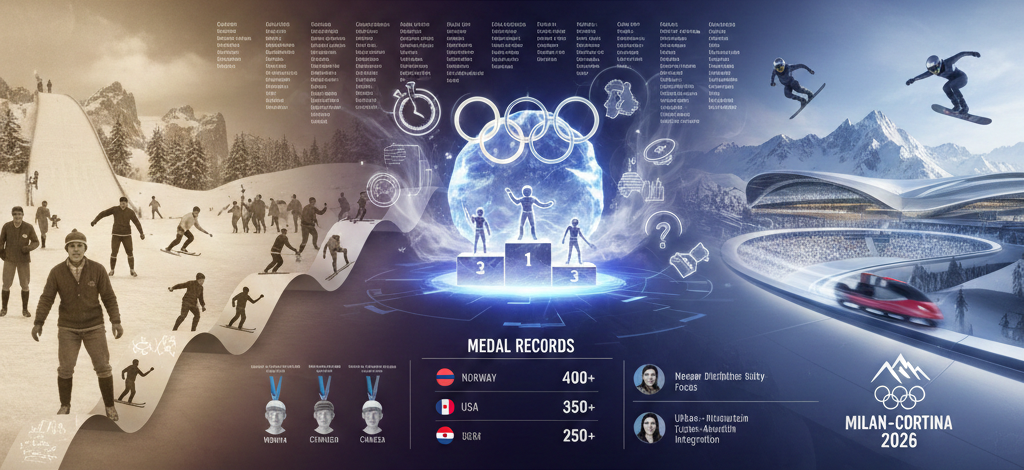
From Ancient Olympia To Chamonix 1924
The modern Olympic idea traces back to the ancient Olympic Games held in Olympia, Greece, from 776 BCE to 394 CE. In 1894, Pierre de Coubertin founded the IOC, leading to the first modern Summer Olympics in Athens in 1896.
Before the Winter Olympics existed, winter sports enthusiasts had the Nordic Games, organised in Stockholm from 1901 onwards. Swedish official Viktor Gustaf Balck pushed strongly for winter sports to be added to the Olympic programme, and figure skating finally appeared at the 1908 London Summer Olympics.
At the 1921 IOC Congress, France was allowed to host an “International Winter Sports Week” in Chamonix as part of its staging of the 1924 Summer Olympics. The week turned into a success, with more than 250 athletes from 16 nations competing in 16 events, and was later rebranded as the first Winter Olympic Games.
For more background on these early events, see our dedicated article on the Nordic Games and pre‑Olympic winter sport.
How The Winter Olympics Evolved (1924–2022)
1924–1948: Early years and war interruptions
Chamonix 1924 featured original sports such as bobsleigh, curling, ice hockey, Nordic skiing and skating (figure and speed). Finland and Norway dominated with 28 medals, more than all other nations combined.
St. Moritz 1928 in Switzerland became the first city to host the Winter Olympics twice and struggled with extreme weather, including a blizzard during the opening ceremony and warm conditions that forced cancellation of the men’s 10,000 m speed skating event. Lake Placid 1932 in the United States was the first Winter Games outside Europe, but the Great Depression limited European participation.
The 1940 and 1944 Winter Olympics, initially awarded to Sapporo and Cortina d’Ampezzo, were cancelled because of World War II. The Games only resumed in 1948 in St. Moritz. For a full chronological overview, visit our list of Winter Olympic Games by year.
1950s–1960s: Television and Soviet dominance
Oslo 1952 introduced the Olympic flame and the first Winter torch relay, which was carried entirely on skis. Cortina d’Ampezzo 1956 became the first Winter Olympics to be televised internationally, effectively testing the global TV model.
The Soviet Union debuted at Cortina 1956 and immediately topped the medal table, using state‑supported “full‑time amateur” athletes. Grenoble 1968 in France was the first Winter Games broadcast in colour and sold TV rights for around 2 million US dollars, more than double Innsbruck 1964.
These decades set up many modern features of the Games, from media coverage to commercial sponsorships, which we explore in detail in our history of Olympic broadcasting rights.
1970s–1980s: New continents, professionalism debates and pop‑culture moments
Sapporo 1972 in Japan was the first Winter Olympics in Asia and highlighted controversies around amateurism when star alpine skier Karl Schranz was barred from competition. Innsbruck 1976 had to step in as replacement host after Denver withdrew over cost concerns, making Innsbruck a two‑time host city.
Lake Placid 1980 produced one of the most famous Winter Olympic moments, the “Miracle on Ice,” when a young US ice hockey team defeated the heavily favoured Soviet squad. Sarajevo 1984 and Calgary 1988 expanded events and introduced demonstration sports like freestyle skiing and short track speed skating.
Calgary 1988 also gave us iconic underdog stories like the Jamaican bobsleigh team and British ski jumper “Eddie the Eagle.” You can read more about these stories in our feature on famous Winter Olympic underdogs.
1990s: Separation from Summer Games and globalisation
Albertville 1992 was the last Winter Olympics held in the same year as the Summer Games. Starting with Lillehammer 1994, the IOC staggered the calendar so Summer and Winter Olympics alternate every two years.
Nagano 1998 welcomed more than 2,000 athletes and saw the NHL allow its players into the men’s ice hockey tournament for the first time, while women’s ice hockey debuted. This period also saw the rise of new winter powers and the emergence of Asia as a serious force in Winter Olympic sports.
2002–2022: Security, mega‑events and new superpowers
Salt Lake City 2002 took place under tight security after the 9/11 attacks and was marred by a pairs figure skating judging scandal that eventually led to dual gold medals. Turin 2006, Vancouver 2010, Sochi 2014, Pyeongchang 2018 and Beijing 2022 continued to expand the programme and athlete numbers.
Sochi 2014 became the most expensive Winter Olympics ever, with total costs estimated at about 51 billion US dollars. Pyeongchang 2018 included new events like big air snowboarding and mass start speed skating, while Beijing 2022 was the first city to host both Summer and Winter Olympics and ran its venues entirely on renewable energy.
For deep dives, see our separate articles: Sochi 2014 cost and legacy analysis and Beijing 2022 key facts and controversies.
Winter Olympic Sports: Full Current Programme
By Charter, Winter Olympic sports must be practised on snow or ice. Over time, disciplines like alpine skiing, luge, short track speed skating, freestyle skiing, skeleton and snowboarding have gained permanent spots on the programme.
Any Winter Olympic Games 2026 complete guide must explain all current Winter Olympic sports and how the programme has expanded over time.
Here is the current core list of Winter Olympic sports with example events:
Alpine skiing – Downhill, super‑G, giant slalom, slalom, combined, mixed parallel slalom.
Biathlon – Individual, sprint, pursuit, mass start and relay races combining skiing and rifle shooting.
Bobsleigh – Two‑man, four‑man, two‑woman and women’s monobob.
Cross‑country skiing – Sprints, skiathlon, mass starts and relays.
Curling – Men’s, women’s and mixed doubles.
Figure skating – Men’s singles, women’s singles, pairs, ice dance and team event.
Freestyle skiing – Moguls, aerials, ski cross, halfpipe, slopestyle, big air.
Ice hockey – Men’s and women’s tournaments.
Luge – Singles, doubles and team relay.
Nordic combined – Ski jumping plus cross‑country skiing for men.
Short track speed skating – Multiple sprint distances and relays, including a mixed relay.
Skeleton – Men’s and women’s head‑first sliding events.
Ski jumping – Individual and team events, plus a mixed team event.
Ski mountaineering (from 2026) – Men’s sprint, women’s sprint and mixed relay.
Snowboarding – Halfpipe, slopestyle, big air, snowboard cross, parallel events, mixed team cross.
Speed skating – Distances from 500 m to 10,000 m plus mass start and team pursuit.
For a sport‑by‑sport breakdown with all events, formats and basic rules, visit our Winter Olympic sports list.
Host Cities: Where The Winter Olympics Have Been Held
So far, the Winter Olympic Games have been hosted on three continents – Europe, North America and Asia – and all host countries are in the Northern Hemisphere. The United States has hosted four times, France three, and Switzerland, Austria, Norway, Japan, Italy and Canada twice each.
One‑time hosts include Germany (Garmisch‑Partenkirchen 1936), Yugoslavia (Sarajevo 1984), Russia (Sochi 2014), South Korea (Pyeongchang 2018) and China (Beijing 2022). No city in the Southern Hemisphere has yet bid to host the Winter Games in their August winter season.
You can see all editions with dates, sports and top medal nation in our full list of Winter Olympic host cities.
Upcoming Winter Olympic hosts
Milan–Cortina d’Ampezzo 2026 (Italy): Scheduled for 6–22 February 2026, with events split between Milan, Cortina and other alpine venues.
French Alps 2030 (France): Bringing the Games back to France for the first time since Albertville 1992.
Utah 2034 (USA): Returning to the region that hosted Salt Lake City 2002.
For more on venues and travel tips, see our Milan–Cortina 2026 visitor guide.
All‑Time Winter Olympic Medal Table
As of the 2022 Games, Norway leads the all‑time Winter Olympic medal table with 405 medals, including 148 golds. The United States is second with 330 medals and is the only country to have won at least one gold at every Winter Olympics.
Germany (counting unified results) has 267 medals, while the Soviet Union’s historical total stands at 194. Canada, Austria, Sweden, Switzerland, the Netherlands, Russia, Finland, Italy and France also rank among the top 20 Winter Olympic nations.
All‑time top 5 Winter Olympic nations (total medals)
| Rank | Nation | Gold | Silver | Bronze | Total | Games | Note |
|---|---|---|---|---|---|---|---|
| 1 | Norway | 148 | 134 | 123 | 405 | 24 | All‑time leader in Winter Olympic medals. |
| 2 | United States | 114 | 121 | 95 | 330 | 24 | Only nation with gold at every Winter Games. |
| 3 | Germany | 105 | 97 | 65 | 267 | 13 | Includes results of unified Germany. |
| 4 | Soviet Union | 78 | 57 | 59 | 194 | 9 | Historical results before dissolution. |
| 5 | Canada | 77 | 72 | 76 | 225 | 24 | Host of Calgary 1988 and Vancouver 2010. |
Norway has led the medal table at ten Winter Olympics, more than any other nation. The Soviet Union topped it seven times, Germany three times, and the United States, Sweden, East Germany, Canada and Russia once each.
We maintain an updated Winter Olympic medal stats hub with sortable tables and nation profiles.
Problems, Politics And Controversies
Host‑city scandals and bribery
The process of awarding Winter Olympic host cities came under intense scrutiny after Salt Lake City was chosen for 2002. Investigations revealed that bid organisers had provided IOC members with gifts, scholarships and other benefits, triggering a major corruption scandal.
Similar issues were found in previous bids, including Nagano 1998, where the value of gifts was described as “astronomical.” The IOC responded by expelling and sanctioning several members, tightening gift rules and adding term and age limits for membership.
Learn more in our in‑depth article on Olympic bid scandals and reforms.
Cost, legacy and ‘white elephant’ venues
Hosting the Winter Olympics is hugely expensive, and most cities do not turn a profit. Turin 2006 cost around 3.6 billion US dollars, while Nagano 1998 reached about 12.5 billion, partly because of the new bullet train link from Tokyo.
Sochi 2014 set a record with estimated costs of about 51 billion US dollars, requiring the construction of almost all venues and supporting infrastructure from scratch. Many hosts struggle with long‑term debt and underused facilities, leading the IOC to insist on “legacy plans” and to fund part of the budget.
For a case‑by‑case breakdown, check our Winter Olympic cost and legacy report.
Doping and the fight for clean sport
Drug testing at the Winter Olympics began in 1968, but methods were inconsistent for many years. In 1999 the IOC helped create the independent World Anti‑Doping Agency (WADA) to coordinate testing and standards.
The 2006 Turin Games saw blood‑doping raids on the Austrian cross‑country team, and the 2014 Sochi Games exposed a large‑scale state‑sponsored doping programme in Russia. Dozens of athletes were sanctioned, and some medals were stripped and later partially reinstated.
We cover these issues in detail in our article on Winter Olympic doping scandals.
Cold War, boycotts and identity
From the Soviet Union’s debut in 1956, the Winter Olympics became an ideological battlefield of the Cold War. Eastern Bloc countries used state‑sponsored “full‑time amateurs,” blurring the line between amateur and professional competition.
The political status of East and West Germany, and later of Taiwan/Chinese Taipei, caused repeated disputes over flags, anthems and team names. Taiwan boycotted the 1980 Lake Placid Games after being required to compete as “Chinese Taipei” and returned under that name in 1984.
For more, see our Cold War and the Olympic Games feature.
Demonstration Sports And Events That Disappeared
Several sports appeared as demonstration events at Winter Olympics but never achieved permanent status. Examples include bandy (Russian hockey), ice stock sport, ski ballet (ski‑acro), skijoring (skiing behind horses or dogs), sled‑dog racing and speed skiing.
Military patrol, a team event combining skiing and shooting, was a medal sport in 1924 and a demonstration event in 1928, 1936 and 1948 before evolving into modern biathlon. Demonstration sports were discontinued after the 1992 Games.
We explore these forgotten disciplines in lost and demonstration Winter Olympic sports.
Future Of The Winter Olympics: Climate And New Directions
Climate change is projected to reduce drastically the number of regions with reliable natural snow, directly affecting possible Winter Olympic hosts. This is pushing the IOC towards reusing existing venues, spreading events over wider regions and giving preference to experienced winter‑sports countries.
Starting with Beijing 2022, the IOC has allowed longer distances between alpine venues and main host cities, and future bids like Milan–Cortina propose widely separated locations. The programme continues to evolve with new sports like ski mountaineering and more mixed‑gender events to keep the Games relevant and inclusive.
We analyse these trends in the future of the Winter Olympics in a warming world.